
Hiroshima Youth Peace Meeting 2024
The Hiroshima Youth Peace Meeting -Peace Study Meeting (to be renamed the National Children's Peace Summit and expanded in scale in 2025), which brings together peace delegations (primarily junior high school students) from different cities participating in the Hiroshima Peace Memorial Ceremony, was expanded in 2024, taking place on both August 5th and August 7th.
A total of 172 students from 17 organizations participated in the Meeting, and they had the opportunity to interact with 70 members of Junior and Senior High School Students Peace Club in Hiroshima.
The Meeting consists of two parts: (1) peace studies on the realities of the atomic bombing, and (2) group discussions on peace.
In the part (1), Peace Club members gave an overview of the damage caused by the atomic bombing. Then Ms. Junko Yamase and Ms. Teruko Yawata shared their personal experiences of the atomic bombing on the 5th and August 7th, respectively.
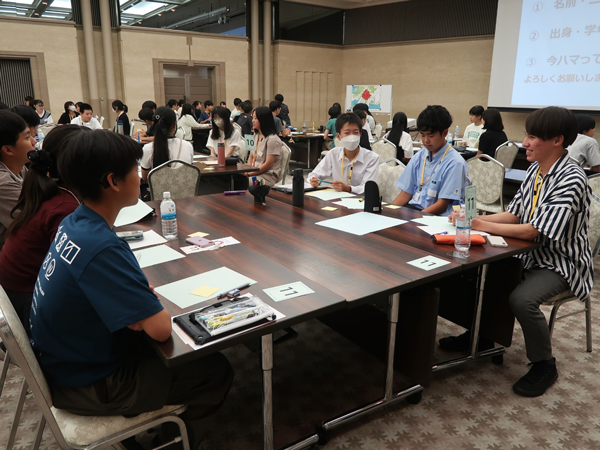
In the part (2), there was a lively exchange of opinions on two themes: "What kind of war experience has your local area had, and how would you like to convey that to others?" and "What can we do to eliminate nuclear weapons?" The results of each discussion were then announced.
 According to a survey of participants, the A-bomb survivor talks were highly rated by 99%, and the group discussions was by 95%.
Furthermore, 89% reported that they learned that "peace is not something to be taken for granted, but something precious," demonstrating the significance of this Meeting.
Here is feedback from the students.
In this sense, we are going to expand this Hiroshima Peace Youth Meeting and hold it in Hiroshima, the city that experienced the atomic bombing, on August 5th, 6th, and 7th this year, the 80th year since the atomic bombing. Since the current younger generation is the last to hear the stories of atomic bomb survivors firsthand, we believe this event will be an extremely valuable opportunity for them. Furthermore, in order to facilitate participation by local governments, the City of Hiroshima is planning to the establish a subsidy system in fiscal year 2025, with financial support from the national government, to assist with the dispatch expenses of children from these local governments.
We sincerely ask all local governments to send children to Hiroshima in 2025 to participate in the Peace Study Meeting.
The Meeting consists of two parts: (1) peace studies on the realities of the atomic bombing, and (2) group discussions on peace.
In the part (1), Peace Club members gave an overview of the damage caused by the atomic bombing. Then Ms. Junko Yamase and Ms. Teruko Yawata shared their personal experiences of the atomic bombing on the 5th and August 7th, respectively.
In the part (2), there was a lively exchange of opinions on two themes: "What kind of war experience has your local area had, and how would you like to convey that to others?" and "What can we do to eliminate nuclear weapons?" The results of each discussion were then announced.
group discussions
Furthermore, 89% reported that they learned that "peace is not something to be taken for granted, but something precious," demonstrating the significance of this Meeting.
Here is feedback from the students.
- Through discussions with students from different areas and hearing a firsthand account from an atomic bomb survivor, I was able to reflect deeply on the meaning of peace. This experience was truly unforgettable.
- Listening to a detailed account of a survivor's experiences, I realized once again how truly tragic the atomic bomb was and how many people it harmed.
- I had a great time discussing various topics with my peers from different regions. I learned a lot of new things and perspectives.
- Learning about a time when the things we take for granted today weren't normal made me want to think about what little I can do for peace in the future.
- Although I feel that we students have very little power to change the world compared to adults, I was encouraged to learn that there are many young people like me who want to take action for peace.
In this sense, we are going to expand this Hiroshima Peace Youth Meeting and hold it in Hiroshima, the city that experienced the atomic bombing, on August 5th, 6th, and 7th this year, the 80th year since the atomic bombing. Since the current younger generation is the last to hear the stories of atomic bomb survivors firsthand, we believe this event will be an extremely valuable opportunity for them. Furthermore, in order to facilitate participation by local governments, the City of Hiroshima is planning to the establish a subsidy system in fiscal year 2025, with financial support from the national government, to assist with the dispatch expenses of children from these local governments.
We sincerely ask all local governments to send children to Hiroshima in 2025 to participate in the Peace Study Meeting.
(Peace Memorial Museum Outreach Division)