
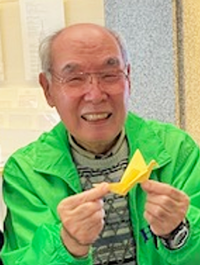
Masao Ito
Hibakusha registered with our Foundation
What prompted me to start giving testimony about my experience
At the time of the bombing I was a child, not even five years old.When I retired at the age of 65, a pastor I knew said to me, "Mr. Ito, what are you going to do every day from now on? How about this?" He showed me an article recruiting Hiroshima Peace Volunteers. I visited the Peace Memorial Museum straight away and applied for it. The person in charge asked me, "Since you are a hibakusha, would you like to give your testimony as well?" But I declined, saying, "Even though I am a hibakusha, I was only 4 years old at the time, so my recollections of the bombing are limited." Then I began to serve as a Hiroshima Peace Volunteer after undergoing the training program.
When the City of Hiroshima established the A-bomb Legacy Successor training program in 2012, I thought, "This may be something I can do." I underwent three years of training as one of the first participants in the program and was commissioned as an A-bomb Legacy Successor in April 2015. As soon as I received my letter of appointment, I headed to Yokohama to participate in Global Voyage for a Nuclear-Free World: Peace Boat Hibakusha Project.
During this voyage, which marked the 70th anniversary of the atomic bombing, we made port calls in member cities to give testimonies as a joint project with the Mayors for Peace. At that time, I was deeply moved by people's reactions to my experience and to the stories I shared as an A-bomb Legacy Successor. In addition, learning about ICAN's activities convinced me that the wish for the abolition of nuclear weapons is not limited to Hiroshima and Nagasaki, but is the wish of all humankind. I think this became the starting point for my subsequent peace activities.
My A-bomb experience
I was exposed to the bomb in front of my house, 3.2km from the hypocenter. I was playing on my tricycle in the street, when a bluish-white light flashed from east to west. At that moment, I was blown several meters away and lost consciousness for a brief moment. When I regained consciousness, I ran home crying. My mother was waiting for me at the front door. When I was about to take off my geta, traditional Japanese wooden sandals, to enter the house, she took me by the hand and said, "Don't worry about taking them off. Come here quickly." I thought that was because the front door and all the windows were broken and shards of glass were scattered all over the house.When my mother turned over one of the tatami mats in the back room of the house, there was an entrance to an airraid shelter, and we rushed inside. I was so young that I had absolutely no idea what was happening.
Our house neither burned nor collapsed. It was in one of the areas that received the greatest amount of "black rain", but we were in an air-raid shelter and were not directly exposed to it.
Meanwhile, I had a 12-year-old brother and a 10-yearold sister. My brother was at Fukuro-machi Elementary School and my sister was at my maternal grandparents' lumber store in Sorazaya-cho. My parents ran a small factory and owned a small truck, so my father was immediately dispatched to help rescue people using the truck. However, the city was on fire, and he was unable to do as much as he had hoped. Late that night my father returned home with my brother, who was covered in wounds, and my parents continued to nurse him as best they could. My sister was less than 1km from the hypocenter and was killed instantly, along with my uncle, aunt, and cousins. To this day, not even her remains have been found.
As a young child at the time, the most vivid and disturbing memories are not of my own family, but of the many people who fled from the city center. We had a large house, so we took in some people, but they died one after another. Because of the August heat, the bodies decomposed overnight, and a foul smell wafted through the air. The bodies were gathered in a nearby open area, where they were cremated. Around ten bodies were piled up, doused in kerosene, and burned. Such scenes appear to have continued for about a week. Those scenes alone have remained vividly etched in my memory and have never left me.
My brother, whom my father had brought home, took his last breath on August 29, three weeks later, despite my parents' devoted care. With the help of our neighbors, he was cremated in the same open area where many bodies were cremated.
Suffering and hardships after the atomic bombing
For those of us who survived, the real hardship came afterward. Five years after the bombing, when I was 10 years old, my father developed what was known as genbaku burabura-byo (atomic bomb fatigue syndrome), a long-term aftereffect of the atomic bombing. He was in and out of the Atomic Bomb hospital. He spent about half of the year in the hospital and the other half recuperating at home. My mother took over the family business, but things did not go well, and we finally had no choice but to move out in the middle of the night, leaving almost everything behind. I had to leave the high school I had just entered and took a live-in job. For a boy of fifteen or sixteen, the work was extremely harsh. Six months later, I developed tuberculosis and was sent to a sanatorium.Although my life has been full of ups and downs since then, I am now living a peaceful life at a nursing home for hibakusha. As an expression of my gratitude for the life I have been fortunate enough to live, I continue my efforts as a Peace Volunteer and a hibakusha who shares my experience at the Hiroshima Peace Memorial Museum, hoping for the early ratification of the Treaty on the Prohibition of Nuclear Weapons as an important step toward a world free of nuclear weapons.
[Masao Ito]
Born in 1941, he was exposed to the atomic bomb at the age of four in front of his home, located 3.2km from the hypocenter.He has served as a Hiroshima Peace Volunteer since 2010. In 2015, he began working as an Atomic Bomb Legacy Successor. That same year, he participated in the "Global Voyage for a Nuclear-Free World: Peace Boat Hibakusha Project". Since 2022, he has been sharing his experience.