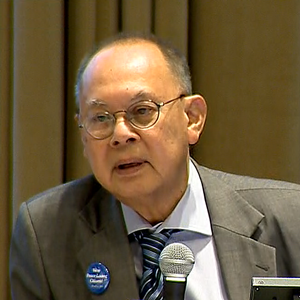
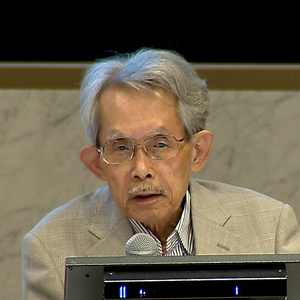
Mr. Kiyoshi Tanimoto, who had been working widely in the U.S. to testify about his experience as a hibakusha, expressed his determination by saying: "A method for making a lasting contribution to world peace must be developed from our own experiences in Hiroshima."
Meanwhile, he also shared his awareness of the problem that "although we have plenty of emotional appeal, we still lack the ideological principles that is necessary for us to powerfully convey our appeal."
The Humanitarian Initiative can be considered to exactly constitute the "ideological principles" that Mr. Tanimoto mentioned.
This is the principle of emphasizing the inevitability of abolishing nuclear weapons, going beyond the theory of national security and nuclear deterrence, on the basis that they can destroy humanity.
It has been supported from over 180 states, and it has provided the strongest grounds for the Treaty on the Prohibition of Nuclear Weapons (TPNW), which entered into force in 2021.
On August 6, 2025, we held an International Symposium to Commemorate the 80
th Anniversary of the Atomic Bombing bringing together hibakusha and leading figures from around the world.
The symposium was aimed at embodying the "catastrophic humanitarian consequences", which provide the basis of the Humanitarian Initiative, based on Hiroshima's experience of the atomic bombing, and declaring our strong support for the initiative.
Approximately 200 people attended the symposium, including 40 ambassadors and other embassy staff from 27 countries represented in Japan, who also attended the Hiroshima Peace Memorial Ceremony, mayors who later attended the Mayors for Peace General Assembly, and promising young people, such as participants in the International Youth Conference for Peace in the Future.
[Part 1: Session with Hibakusha]
Part 1 of the symposium was dedicated to a session featuring the testimonies of hibakusha.
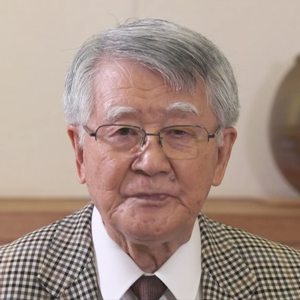
It began with a screening of a 20-minute video titled "The Experience of Hiroshima that Embodies the Destruction of Humanity" (featuring testimonies from four hibakusha: Akiko Takakura, Akihiro Takahashi, Yoshito Matsushige, and Shunichiro Arai).
This was followed by a session moderated by Dr. Luli van der Does, Director of the Center for Peace and Associate Professor at the Graduate School of Humanities and Social Sciences, Hiroshima University.
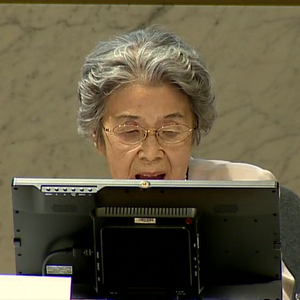
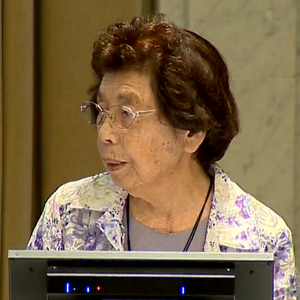
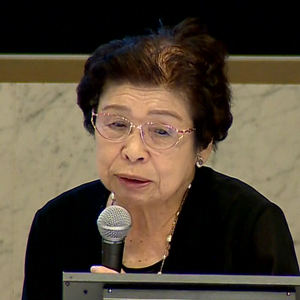
Three hibakusha—Sadae Kasaoka, Yoshiko Kajimoto, and Kiyomi Kono—took to the stage to testify about their experiences.
The testimonies of the seven hibakusha provided a basis for verification of how nuclear weapons could destroy humanity (the catastrophic humanitarian consequences of the use of nuclear weapons).
The specific content of the session can be outlined as follows:
[Damage caused by intense heat rays]
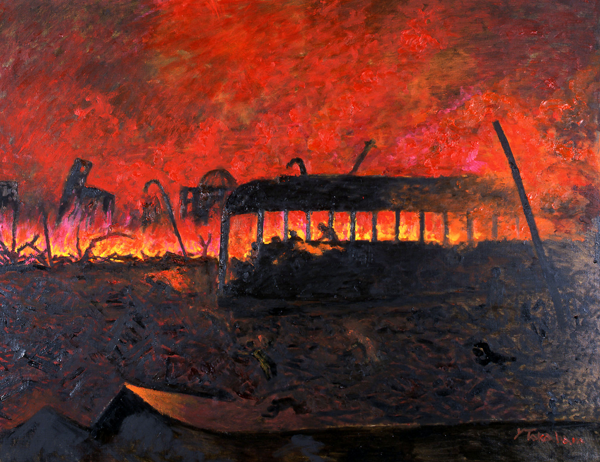
"(Immediately after being exposed to the bombing inside the office near the hypocenter,)
I left and tried to escape to the military drill ground, but the entire field was a sea of fire—truly a sea of fire!
The temple behind the office was also destroyed and burning."
(Ms. Takakura)
Burning Streetcar
Painted by Yoshio Takahara
(Source: Hiroshima Peace Memorial Museum)
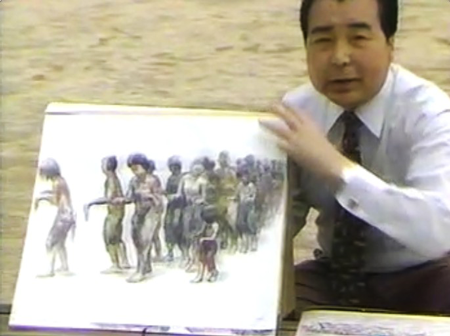
"On my way (while evacuating), I saw many hibakusha fleeing in a line.
Everyone had their arms stretched out in front of them, with skin hanging down in strips, and their clothes in tatters, leaving some practically naked.
Among them were a man with shards of glass embedded in his body, another man whose skin was peeling away, a woman whose eyeball had been forced out, and another woman whose body was covered in blood.
There were dead bodies lying around, their internal organs spilled out.
The mother and her baby, both with severe burns, were also lying at the side of the road.
I heard the baby wailing, and I can still hear the cries in my ears.
I found a horse, whose entire body was burned, dead with its head stuck in a water tank.
There is an expression 'hell on earth', and what we experienced after the bombing was exactly that 'hell on earth'."
(Mr. Takahashi)
A line of fleeing hibakusha
Testimony of Akihiro Takahashi
(Source: Hiroshima Peace Memorial Museum)
"From the hypocenter came people who looked like ghosts with their arms stretched forward, their burned skin hung down from their fingertips like rags.
Their clothes were either blown away or burned off, leaving them completely naked.
Their faces were swollen like balloons, their lips turned up, and blood was flowing from their heads and other parts of their bodies.
Staggering in a line, they looked like a procession of ghosts.
Among them was a middle school boy holding his severed arm, who collapsed and died right in front of me.
His terrified, sorrowful face remains in my memory.
A mother cradled a dead baby wandering around in madness, screaming incoherently.
These wretched figures kept coming.
None of them looked human.
...The city was littered with corpses.
Despite trying not to step on them, I remember vividly the slippery sensation of stepping on dangling skin.
On the streets were people with their eyes protruding, others with their entrails spilling out, pieces of flesh scattered around, and the smell of blood—it was hell on earth itself."
(Ms. Kajimoto)
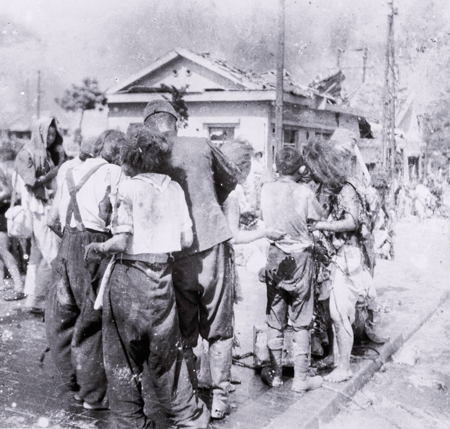
"To the west of Miyuki-bashi Bridge was a police station, and two police officers were dabbing cooking oil onto people's burns.
Most of the people there were first- and second-year junior high school students.
They had been directly exposed to the heat rays while working outside to demolish buildings to prevent fires from spreading.
On their backs, faces, shoulders and arms, ball-shaped blisters had formed.
Those blisters were torn and the skin was hanging down like rags.
Probably from running barefoot through fire, some children even had burns on the soles of their feet.
...I hesitated to take pictures for about 20 minutes, struggling with whether I should photograph people who were suffering like this.
In the end, I managed to get one shot, then moved about 4 - 5 meters closer to take a second.
I still remember that hell on earth clearly."
(Mr. Matsushige)
Hibakusha at the west end of Miyuki-bashi Bridge
Photo: Yoshito Matsushige
(© The Chugoku Shimbun Collection:
Photo Archives of Japan)
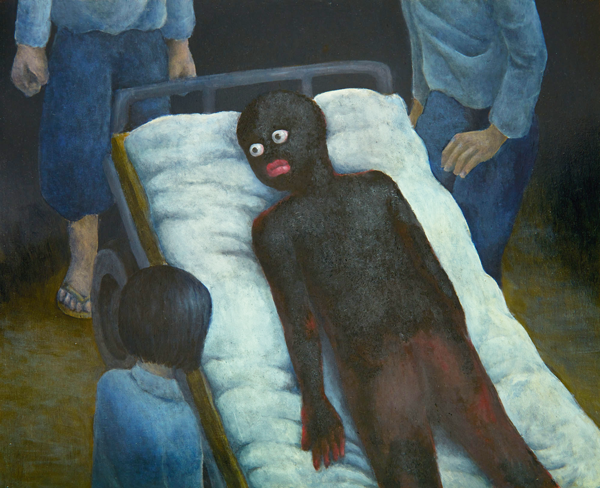
"When I saw my father lying on the wooden board, I couldn't believe he was alive.
His face was swollen and his clothes were burned, leaving his entire body shining black.
It was only when I heard his voice that I realized he was my father.
We had no medicine, so we grated cucumber and potato, and used them as compresses.
His body was burned and hot, so they dried quickly.
When we touched the blackened areas, they peeled off, revealing red skin underneath.
His burns were not only on the surface but deep inside as well.
...My father passed away on the night of August 8, deeply worried about my missing mother and us, his young children."
(Ms. Kasaoka)
"Are You Really Dad?"
Painted by Minami Ogawa
(Source: Hiroshima Peace Memorial Museum)
[Damage caused by tremendous blast wind]
"We were all looking up at the sky (in the middle school playground) and pointing, watching the plane go by.
That's when it happened.
There was a tremendous roar, and everything was plunged into darkness.
It was so dark that we couldn't even see our hand in front of our face.
I had been blown off by the blast.
...After it got light, I realized that I had been blown about 10 meters backwards.
All my friends had also been blown away, lying all over the schoolyard.
The school and the neighboring houses were destroyed, and when I looked off into the distance, it seemed like the whole city of Hiroshima had disappeared."
(Mr. Takahashi)
"(When I finally managed to get out from under the collapsed building,)
I found the city of Hiroshima flattened.
The scorching sun that had been shining so brightly was gone.
It was dark and eerily quiet, and there was a strange smell like rotten fish.
Five or six friends made it out from under the collapsed building.
Their hair was standing on end, their bodies completely blackened, some were bleeding from their heads, some had their flesh torn off their arms so that their skin was hanging, and some had their flesh torn off their legs so that their bones were visible.
Their white uniforms were soaked in blood.
Everybody was half-mad.
One friend who had been pinned under the debris was the worst injured.
Her arm was dangling, barely attached by a single piece of skin, making the bone visible.
It was so pitiful and scary to look at."
(Ms. Kajimoto)
"I was resting at home that day (August 6).
(The moment the atomic bomb was dropped,)
I saw everything outside my window turning bright red.
No, it was a beautiful color like the rising sun mixed with orange.
At that moment there was a loud "boom" and at the same time, the glass broke into pieces and flew towards me.
The tremendous pressure of the blast pushed me backwards and I lost consciousness for a moment.
...We couldn't just sit in fear, so we went outside.
Houses had caught fire, were tilted, and their roof tiles and walls were scattered around them.
(Ms. Kasaoka)
[Damage caused by radiation]
"I was bedridden throughout the rest of August.
I had no appetite, with a high fever and profuse bleeding gums.
The wound on my arm had festered.
It was crawling with maggots.
My grandmother, crying as she did so, picked them out one by one with chopsticks.
...My father was exposed at home, 2.5 kilometers from the hypocenter.
Although he suffered neither burns nor other injuries at the time, about a year and a half later, he began vomiting blood and died shortly thereafter.
I believe it was because he was exposed to residual radiation from walking through the burnt ruins for three days, turning over corpses in his search for me.
...Later, in 1999, I underwent surgery to remove two-thirds of my stomach due to stomach cancer.
Many of my friends also died of cancer.
Even now, 80 years later, I continue to develop new diseases, suffering from anemia and brain tumors."
(Ms. Kajimoto)
"Actually, I'm currently suffering from my sixth cancer.
The first time I was diagnosed with cancer was in 1984, when I was in my 50s.
That first cancer was found in my right kidney and I later developed cancer in various parts of my body, and lived on the verge of death.
My doctor told me that I was a typical patient with multiple cancers caused by radiation.
Now I have another kidney cancer, and there is nothing that can be done about it.
And it is at stage 4.
This is my destiny.
That is to say, the impact of the atomic bombing of Hiroshima did not end 80 years ago.
It is still affecting all hibakusha, just as shown by myself.
I will continue to testify about that as a living witness."
(Mr. Arai)
[Devastation of downtown Hiroshima]
"The moment I got off the train on the platform at Yaga Station, I was hit by an awful stench, like the smell of burnt animals or rotting flesh.
It stung my eyes and nose, and made it hard to breathe.
I finally got used to it and opened my eyes.
I was shocked.
I found no trace of the city of Hiroshima or the houses that had stood there until the last day.
Smoke was still smoldering here and there."
(Ms. Kono)
"When I entered the city, I found dead bodies scattered everywhere.
The bodies exposed to the heat rays had turned dark brown and swollen.
I couldn't tell if they were men or women.
There were people whose eyes were flowing and jelly-like; others whose tongues were triangular and sticking out like horns; and still others whose internal organs had ruptured and turned a dark yellow in color.
Brains had also flowed out.
It was the scariest memory of my entire life."
(Ms. Kono)
"The Japanese Red Cross Hospital was in a terrible state, with all the windows blown out by the blast.
I saw many bloodied people being carried in from all directions.
They were laid in rows at the entrance, and in the hallways.
They were crying: 'It hurts! It hurts!' 'Help me!' 'Give me water!' or 'Mom!'
An old woman in a yukata robe said: 'I'm already old, so just end my life quickly.'
The cries echoed off the concrete walls of the hospital, growing into a loud, wailing roar.
There was also a shortage of doctors and nurses, as many of them were injured.
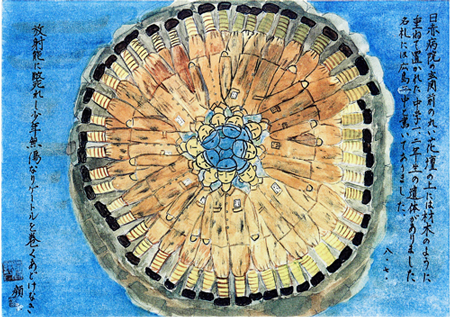
...There was a large round flower bed at the driveway at the hospital.
I had always seen it, lush and green, but that day the bodies of boys were carelessly piled up like logs.
I thought they were exposed to the atomic bomb while working together to demolish buildings around there.
Even though they were first-year junior high school boys, they had the physique of fifth graders due to the lack of nutrition.
They had an innocent look on their faces and looked like they were asleep.
They must have wanted to go home and see their mothers, but not a single one was able to be with their parents, and they were all cremated together."
(Ms. Kono)
Corpses on a Flowerbed
at Japanese Red Cross Hospital
Painted by Kiyomi Kono
(Source: Hiroshima Peace Memorial Museum)
"Looking down at the river from Miyuki-bashi Bridge, I saw many pure white corpses floating, some facing up and some facing down.
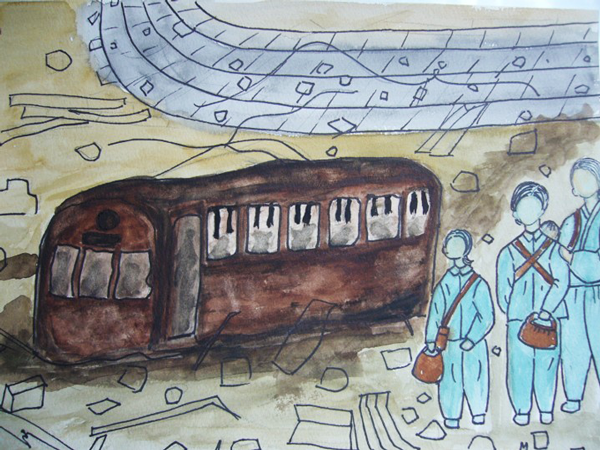
...Near the hypocenter, I happened to look at a streetcar and saw something black hanging inside.
Wondering what they were, I looked closer and found that they were arms holding the straps, torn off from bodies.
They were charred like coal.
This terrified me as well, because there was no human figure left.
Soldiers were crouching in front of the Fukuya Department Store.
These soldiers were not bleeding and their clothes were not dirty.
It was strange, but in hindsight, I think they had died from exposure to radiation."
(Ms. Kono)
Arms Holding onto Straps
Painted by Kiyomi Kono
(Courtesy of Kiyomi Kono)
Dr. Luli van der Does concluded the session by stating:
"The atomic bomb destroyed the entire city in an instant, and many of the citizens who lived there suffered truly horrible deaths.
Corpses were piled high in the streets and the squares of Hiroshima, and many citizens were burned and seriously injured, yet they wandered like ghosts, trying to return home where their families were waiting.
Unfortunately, many lost their lives just after returning home.
Furthermore, the radiation from the atomic bomb caused not only immediate acute injuries, but also, 80 years later, continues to inflict leukemia, cancer, and numerous physical and psychological sufferings.
All these actually happened.
...What we want to convey is that such a catastrophic and inhumane outcome must never be repeated, so that we can continue to exist.
Humanity and nuclear weapons can't coexist.
No matter what else we may lose, what we must never lose is life itself.
I hope you will think about what we can do now to continue preserving our lives.
And when you recall the stories of hibakusha, please imagine your own face and the faces of those you love overlapping with theirs.
Nuclear weapons kill instantly and indiscriminately; they are inhumane weapons.
If we want to protect those we love, we must choose to eradicate nuclear weapons from this earth."
[Part 2: Panel Discussion]
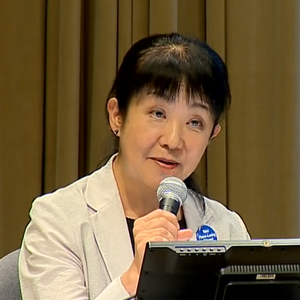
The second part of the event was a panel discussion moderated by Dr. Keiko Nakamura, Associate Professor, Research Center for Nuclear Weapons Abolition (RECNA), Nagasaki University.
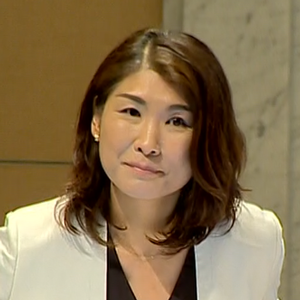
The panelists were Ms. Izumi Nakamitsu, United Nations Under-Secretary-General of Disarmament Affairs and High Representative for Disarmament Affairs;
Ambassador Alexander Kmentt, then Director of the Disarmament, Arms Control and Non-Proliferation Department of the Austrian Foreign Ministry (now Austria’s Permanent Representative to the UN in Geneva);
the Honorable Melissa Parke, Executive Director of the International Campaign to Abolish Nuclear Weapons (ICAN);
Professor Emeritus Mitsuru Kurosawa, Osaka University;
the Honorable Kasit Piromya, Special Advisor of Mayors for Peace and former Foreign Minister of Thailand;
and Mr. Shiro Tani, Vice-Chairperson of the Hiroshima Peace Culture Foundation and Deputy Secretary-General of Mayors for Peace.
They discussed the importance of placing the Humanitarian Initiative at the center of all discussions on nuclear disarmament and the role that Hiroshima should play in this regard.
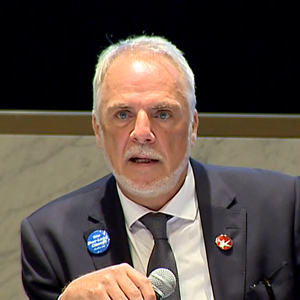
At the beginning of the discussion, Ambassador Kmentt stated his view on this issue as follows:
Ambassador
Alexander Kmentt
"The Humanitarian Initiative offers a way to look at what nuclear weapons do when they are used―not in a sanitized, abstract way in which they are often discussed in nuclear diplomacy.
Because when we understand the magnitude of the devastation and the threat it poses to all life on the planet and to the survival of humanity, looking at them from a narrow national security perspective as tools for national defense seems completely absurd and anachronistic.
The Humanitarian Initiative, therefore, also means discussing nuclear weapons from a planetary security perspective.
I still think that the arguments, the scientific evidence and the human experiences, such as the testimonies of hibakusha, remain the best way to have more impact on the nuclear-weapon states and to move away from reliance on nuclear weapons.
Today much more reliable data and scientific evidence is available about the catastrophic, complex, and cascading humanitarian consequences and risks of nuclear weapons that would affect populations and cities all over the world in dramatic and possibly existential ways than we have reliable evidence about the effectiveness of nuclear deterrence.
Nuclear deterrence remains a theory that is fraught with uncertainties and is based on many assumptions.
The belief in nuclear deterrence as a guarantee of security should therefore be subject to much more critical scrutiny.
In addition, scientific research has the risk of being abstract, which is why it should go together with human stories based on the real experiences of nuclear weapons, such as from hibakusha."
"With nuclear weapons, we do not have the luxury of waiting for progress on nuclear disarmament until we have a more peaceful world.
We must make progress now and this requires us to change the discourse on them as well.
Change will come through a much broader international and societal discourse involving informed citizens.
Nuclear weapons are an absolutely crucial issue for the survival of humanity.
However, proponents of nuclear weapon want to keep this discourse limited to the security expert field, which is simply too limited.
Bringing about a much wider discourse across society, including at the city level, is very important to influence decisions and policies at the state level."
"Understanding nuclear weapons really means understanding what these weapons do when they are used.
I am convinced that the deeper citizens understand the catastrophic consequences and the risks of nuclear weapons, the clearer the case for the inevitability of nuclear abolition becomes.
We may not like to confront such terrible issues, but I think, with nuclear weapons, it is absolutely crucial."
"I'm a great fan of Mayors for Peace, their approach and activities.
I hope that Mayors for Peace will continue to raise public awareness through various programs such as peace education and influence state-level decisions and policies through a bottom-up approach.
I believe that Mayors for Peace's strategy of raising awareness at the citizen level of the devastating effects of nuclear weapons is really crucial.
I highly commend the role that the city of Hiroshima and Mayors for Peace have played so far in promoting such peacebuilding efforts, and I look forward to the continued leadership and engagement."
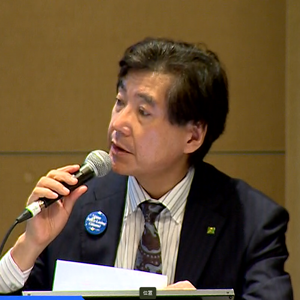
Next, Vice Chairperson Tani explained the role that Hiroshima should play in supporting the Humanitarian Initiative from the following four perspectives.
He then sought the panel's opinions.
1. Embodying the concept of the Humanitarian Initiative
-
As explained in the Session with Hibakusha in Part 1, this means conveying the specific details of the "catastrophic humanitarian consequences" of the use of nuclear weapons based on the experiences of the atomic bombed cities.
I believe that the deeper citizens understand the specific details of those consequences, the more convinced they will become of the inevitability of abolishing nuclear weapons.
-
In April 2026, the Hiroshima Peace Memorial Museum will launch a new exhibition on the inhumanity and devastation of the atomic bombing.
We will also post concise videos presenting the consequences on our website and enhance overseas atomic bomb and peace exhibitions.
2. Working hand in hand with peace-loving cities and citizens
-
A city with the mission of protecting citizens' lives inevitably moves toward the pursuit of peace.
When a war breaks out, it is cities and citizens that suffer, and it is also cities that carry on the memory of the damage and the desire for peace.
-
Many cities both in Japan and abroad have empathized with Hiroshima as a symbol of peace and declared their intent to work together with Hiroshima in pursuit of peace.
-
Against this background, Mayors for Peace, chaired by the mayor of Hiroshima, has grown into the world's largest peace networks of local governments with 8,500 member cities in 166 countries and regions.
-
At a time when suspicion between nations is strong, we have to overcome nationalism and make the human-centered idea of the Humanitarian Initiative a common base of the international community.
Peace-loving cities (Mayors for Peace) must take a citizen-centered approach and make bottom-up efforts to build this base.
3. A hub to promote peace education for the younger generation
-
Hiroshima has made efforts to preserve exhibits at the Hiroshima Peace Memorial Museum, as well as the Atomic Bomb Dome.
Grasping the realities of the atomic bombing will make learners conscious of the value of peace, which will be essential as a starting point for peace study.
Therefore, Hiroshima intends to continue to serve as a hub for peace education for the younger generation.
-
In the process, we will seek widespread understanding of the inhumanity and catastrophic nature of nuclear weapons.
-
In this context, the museum is planning to launch a new peace study exhibition in April 2028.
4. Conveying "Hiroshima's spirit for peace"
-
Hibakusha's hope - "no one should ever suffer as we have experienced." - shows Hiroshima's stance of pursuing peace by transcending deep sorrow and hatred based on altruism and tolerance.
This idea is the origin and driving force of Hiroshima's peace activities.
-
In the sense that it gives meaning to the deaths of the atomic-bomb victims, it represents the restoration of human dignity and also leads to human security.
-
Hiroshima must continue to spread this spirit as the cornerstone of world peace and the basis of the Humanitarian Initiative.
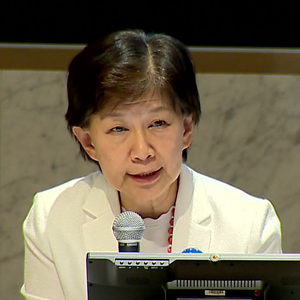
UN Under-Secretary-General Ms. Nakamitsu made remarks as summarized below:
"At the United Nations, we value the Humanitarian Initiative so much.
The Initiative began to be advocated around 2010 and led to the Treaty on the Prohibition of Nuclear Weapons (TPNW) after a couple of very important international conferences.
In that process, there are three key contributions of this Initiative.
First, it reframed the nuclear weapons discourse.
It has caused a shift from the conventional state-centric security discourse to more human-centered disarmament discourse, which emphasizes human suffering as a result of these inhumane weapons.
Second, these humanitarian approaches strengthen the evidence-based understanding of humanitarian consequences.
These data and evidence have been very important contributions to the entire discussions on the nuclear disarmament discourse, and now this is going to be further developed.
Third, the Humanitarian Initiative has enabled everyone to understand that the impact of nuclear weapons is not limited to nuclear-weapon states but has a global impact on the survival of humanity.
In the current geopolitical tensions, we need to highlight this approach and further develop this discourse."
"The Humanitarian Initiative is not just in the TPNW context but is often discussed in the First Committee of the UN General Assembly context.
So that is why I think it is upon all of us to further develop this Humanitarian Initiative, because it will help us."
"The UN Secretary-General always receives delegations from Mayors for Peace whenever they visit New York.
Cities are actually closer to citizens and are more directly affected by wars and weapon systems that are so inhumane.
For this reason, we need to make sure that we promote the ideas and concepts of coexistence and tolerance.
The immediate humane impact of violence and conflict has to be really highlighted.
That is why the role of local governments is vital.
The United Nations is an intergovernmental platform, and we tend to overlook the roles played by civil societies and local governments.
However, cities are vital peace actors.
We seek their contributions.
We need to make sure that we have what we call multi-stakeholder approaches, where the intergovernmental discussions and negotiations are enriched by those various perspectives."
"Mayors for Peace, Hiroshima, and Nagasaki are already very important partners of the United Nations.
The testimonies of hibakusha have already contributed enormously to the UN discussions.
We hope to continue to work with them to promote, for example, peace education."
"I think that the spirit of Hiroshima is a very unique contribution.
Non-Japanese visitors to the Hiroshima Peace Memorial Museum are really impressed that Hiroshima started to be a peace activist instead of taking the path of revenge.
The spirit of Hiroshima is a spirit of tolerance and of collectively seeking a more peaceful path based on the belief that they don't want any other people, any other persons to go through such tragic experiences.
It is a very important message to the international community that peace and stability cannot be built on fear or domination.
More sustainable peace and security can be achieved through collectively working on addressing many of those differences, fostering cultural understanding, promoting mutual understanding and the concept of shared humanity.
I think that the spirit of Hiroshima is about focusing on the similarities and shared humanity, rather than on differences.
And it has deeply impressed and inspired the world.
Hiroshima and Nagasaki are sending a very powerful message to the world that peace can only be made through empathy, dialogue, and human connections."
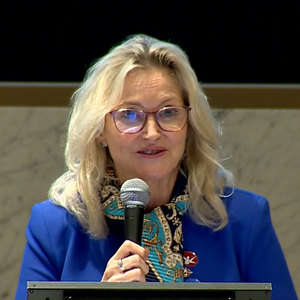
ICAN Executive Director Parke made remarks as summarized below:
"Hibakusha have told their stories again and again so that the world would know the reality of nuclear weapons.
They are the true experts on nuclear weapons, and the Treaty on the Prohibition of Nuclear Weapons (TPNW) is a direct outcome of their efforts.
This contribution was recognized last year with the Nobel Peace Prize awarded to Nihon Hidankyo."
"By sharing the stories of hibakusha, we hope to awaken the global public to the grave and growing threat posed by nuclear weapons and ensure that no one else, young or old, ever suffers the same fate."
"In addition, ICAN has been working with Hiroshima and Nagasaki to draw public attention to the unique and disproportionate harm that nuclear weapons inflict on children."
Mr. Piromya, Special Advisor to Mayors for Peace, made remarks as summarized below:
"The cities around the world are working together for peace under the leadership of Hiroshima and Nagasaki.
Keep on working.
We have to work together at the people's level and at the community level, to bring knowledge about the danger of nuclear weapons to ordinary citizens.
The United Nations can definitely come forward in a strong manner to work together with the cities to disseminate the danger of nuclear weapons to the younger generation."
Professor Emeritus Kurosawa made remarks as summarized below:
"I believe that all young students should study peace in Hiroshima and Nagasaki.
In this regard, the Hiroshima Peace Memorial Museum makes a very important contribution.
Universities should also provide peace education and conduct research aimed at the nuclear issues."
"In the current international society, states are main actors, and nuclear weapon states in particular have great power.
I believe that non-state actors, such as the United Nations, NGOs, and cities, should work more strongly and speak up.
States are just seeking power, but we are seeking peace and stability based on humanity.
We should pursue this kind of world in the longer run.
And the non-state actors should work more peacefully without power."
To conclude the panel discussion, Vice Chairperson Tani stated that based on the abovementioned precious opinions shared during the discussion, Hiroshima's initiatives should be actively promoted in cooperation with the international community.
(Reference videos)
For understanding the inhumanity of nuclear weapons: 19-minute video avairable
(Peace Culture Planning Division)