
Peace Studies for the Younger Generation Initiated Nationwide
(Hiroshima Peace Studies Promotion Program)
―Discover a new self through a heartfelt experience in Hiroshima, an atomic-bombed city―
The Hiroshima Peace Studies Promotion Program, comprising the 1st Japan Children's Peace Studies Gathering and the 1st Japan Children's Peace Summit, was implemented to provide an opportunity for elementary, junior high, and high school students who were dispatched from across Japan to attend the Hiroshima Peace Memorial Ceremony on August 6 to deepen their understanding of peace.
With the participation of 1,319 children and 489 chaperones from 112 municipalities in 26 prefectures and 546 host staff members, totaling 2,354 participants, the program offered a large-scale and enriching learning opportunity, marking the first step toward promoting peace education for the younger generation on a national scale.
Furthermore, two-thirds of the participating municipalities reported that the culture of peace in their communities has been significantly enhanced through the initiatives and messages shared by the children.
We look forward to welcoming many peace-loving municipalities in FY2026 as well.The 1st Japan Children's Peace Studies Gathering
For three days from August 5 to 7, a total of 1,446 participants, including 828 children and 285 chaperones from 72 municipalities in 22 prefectures and 333 Youth Peace Volunteers from 15 municipalities in 5 prefectures who had received training on the realities of the atomic bombing and facilitation techniques, took part in peace studies activities held at seven venues throughout Hiroshima City.
The first part of the event, the "Peace Studies Session", began with Youth Peace Volunteers giving an overview of the damage caused by the atomic bombing. This was followed by a testimony sessions by Mikio Saiki, Yoshiko Kajimoto, Sadae Kasaoka, Teruko Yahata, Kiyomi Kono, Hiroko Kishida, and Shingo Naito at each venue. After sharing their experiences, they responded clearly to various questions from the participants.
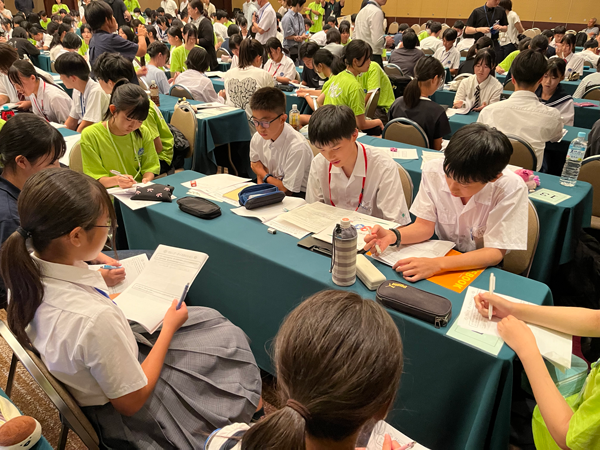
In the second part, the "Group Discussion", participants and Youth Peace Volunteers engaged in group discussions over an extended period on two themes: 1) What kind of damage did your hometown suffer during World War II? and 2) What situations today can be considered as lacking peace, and how do you think they can be resolved?
The survey revealed the following insights regarding the significance of this gathering:
The 1st Japan Children's Peace Summit
After the ceremony on August 6, the summit was held at the Phoenix Hall of the International Conference Center Hiroshima, with the participation of 708 children and 281 chaperones from 63 municipalities in 19 prefectures and 213 staff members from Hiroshima, totaling 1,202 participants.
At the opening, Izumi Nakamitsu, United Nations Under-Secretary-General and High Representative for Disarmament Affairs, greeted the participants and encouraged them to reflect on three questions: "What is peace?" "How can we create peace?" and "What can you do?" Following this, students from Hiroshima Special Needs High School sang the song "Itsumademo (Forever)" while projecting messages of peace on the screen, marking the start of the summit.
In the first part, "Learning about the Atomic Bomb Experience", participants first watched a virtual reality video simulating the atomic bombing and postwar reconstruction in Hiroshima. Afterward, Fumiaki Kajiya shared his hibakusha testimony and answered participants' questions. Then, after listening to poems by volunteer readers, all participants read aloud the atomic bomb poem "Genshi Bakudan (The Atomic Bomb)".
In the second part, "Passing on the Baton of Peace (Presentations on Efforts for Peace)", eight groups gave presentations and shared their thoughts on peace. These included reports on the activities of the Kitahiroshima City Children's Ambassadors (Hokkaido), Ichihara City Peace Ambassadors (Chiba), and Ishigaki City Peace Ambassadors (Okinawa), as well as initiatives to eliminate bullying in Okaya City (Nagano) and peace and community contribution activities by students from Hiroshima City and Nagasaki City. The survey revealed the following insights regarding the significance of the summit:
Furthermore, two-thirds of the participating municipalities reported that the culture of peace in their communities has been significantly enhanced through the initiatives and messages shared by the children.
We look forward to welcoming many peace-loving municipalities in FY2026 as well.
The 1st Japan Children's Peace Studies Gathering
—Peace for Smile, Smile for Peace—
For three days from August 5 to 7, a total of 1,446 participants, including 828 children and 285 chaperones from 72 municipalities in 22 prefectures and 333 Youth Peace Volunteers from 15 municipalities in 5 prefectures who had received training on the realities of the atomic bombing and facilitation techniques, took part in peace studies activities held at seven venues throughout Hiroshima City.The first part of the event, the "Peace Studies Session", began with Youth Peace Volunteers giving an overview of the damage caused by the atomic bombing. This was followed by a testimony sessions by Mikio Saiki, Yoshiko Kajimoto, Sadae Kasaoka, Teruko Yahata, Kiyomi Kono, Hiroko Kishida, and Shingo Naito at each venue. After sharing their experiences, they responded clearly to various questions from the participants.
In the second part, the "Group Discussion", participants and Youth Peace Volunteers engaged in group discussions over an extended period on two themes: 1) What kind of damage did your hometown suffer during World War II? and 2) What situations today can be considered as lacking peace, and how do you think they can be resolved?
The survey revealed the following insights regarding the significance of this gathering:
Group discussions at the 1st Japan Children's Peace Studies Gathering
〈Participating children〉
- The program was filled with valuable experiences, and for the first time, I truly understood what it means to wish for peace. It was a meaningful time full of new discoveries and learning.
- It was a great opportunity unlike anything I had experienced before, and it contributed to my personal growth. I want to be one of the people who help create a peaceful world.
- I was reminded that it is up to us to build a peaceful future. I want to participate again and hope this program will continue.
- The words of hibakusha, who are becoming fewer each year, carried tremendous weight. Their heartfelt appeals and cries for peace moved me more deeply than ever before, beyond what I could have imagined. Listening to the tragedies of their families made me realize how fortunate we are to enjoy the things we take for granted. I was also grateful for the opportunity to interact with hibakusha during the Q&A session, where they kindly answered our questions.
- Through the group discussions, I was exposed to diverse opinions that I would not have been aware of on my own, which helped deepen and broaden my thinking. This experience also made me reflect on what happiness truly means.
- I didn't think we would be able to have such discussions, so it was a really good opportunity to realize that we actually can. Although I was nervous about meeting everyone for the first time, the Youth Peace Volunteers facilitated the discussion kindly and carefully, creating a friendly and enjoyable atmosphere. I made many friends, which was very encouraging.
- I learned that there are many people across the country who share the same wish for peace. I realized that we are all striving for the same goal and united at heart. I believe that we can move closer to achieving peace by addressing small issues, such as eliminating discrimination.
〈Chaperones〉
- I believe that bringing children together from across the country to reflect on peace is valuable and helps build a better future. It was also meaningful for us chaperones, as we learned a lot from the high level of awareness and dedication of the Youth Peace Volunteers in Hiroshima.
- This is an excellent initiative targeting municipalities across the country, and I felt that its driving force was the passion of the Hiroshima staff. I hope it continues in the future.
- The discussions, in which children from all over the country who didn't know each other were well grouped, were excellent. Opportunities to actively discuss and present with peers of the same generation are rare and valuable, fostering independent learning. It was wonderful to see young people listening to one another, observing each other's expressions, and feeling each other's passion throughout the discussions.
- After the event, the children talked with one another about what they had learned and felt, with their eyes sparkling. They said they wanted to start by doing what they could. It was a wonderful and inspiring opportunity for them to experience something authentic.
- Thanks to subsidies from Hiroshima City, the barrier to participation from distant areas has been lowered, making it easier to secure a budget even under tight financial conditions. It also provided a reason to continue the program even in the face of potential downsizing.
- Since a follow-up presentation event is built into the program in advance, the participating children are highly motivated, and the initiative is expected to create a positive ripple effect in their local communities.
〈Youth Peace Volunteers〉
- It was a truly rewarding volunteer experience, where I was able to share a message of peace across Japan, improve my communication skills, and make friends from various regions. My perspective on peace has changed dramatically, and the range of my activities has broadened. It was a wonderful summer.
- As this year marks the 80th anniversary of the end of World War II, I was able to share with my fellow volunteers a strong determination to not let the memory of the war fade away. I had meaningful discussions with like-minded people. I realized the importance of cooperation and how each person's small actions can lead to a great impact.
- All the pre-event training sessions were enjoyable, and my passion for peace and motivation for the real event gradually grew. I gained many new ideas and pieces of knowledge that I had never thought of before. The training sessions gave me confidence, and during the actual group discussions, I was able to engage in meaningful and fulfilling conversations, which left me with a great sense of satisfaction.
- It was a valuable experience that helped me change. I was surprised by how much I had grown, as I was able to start conversations and share topics during the main event, which I couldn't do at first. I learned many things that I couldn't learn at school, such as the importance of looking at things from different perspectives and how to create a positive atmosphere among people I don't know. I believe these skills will be useful in my future school life as well as in many everyday situations.
- Participants from other regions had conducted thorough research beforehand and gave clear, easy-to-understand presentations, which allowed me to learn that every region across the country had suffered its own war damage.
- I would like to continue participating in the program. Hopefully, I would like to engage in peace activities, such as having discussions with young people from overseas and guiding them.
The 1st Japan Children's Peace Summit
—Peace for Smile, Smile for Peace—
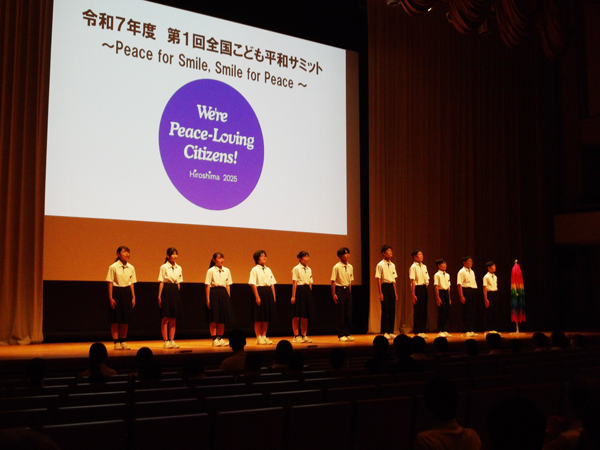
After the ceremony on August 6, the summit was held at the Phoenix Hall of the International Conference Center Hiroshima, with the participation of 708 children and 281 chaperones from 63 municipalities in 19 prefectures and 213 staff members from Hiroshima, totaling 1,202 participants.At the opening, Izumi Nakamitsu, United Nations Under-Secretary-General and High Representative for Disarmament Affairs, greeted the participants and encouraged them to reflect on three questions: "What is peace?" "How can we create peace?" and "What can you do?" Following this, students from Hiroshima Special Needs High School sang the song "Itsumademo (Forever)" while projecting messages of peace on the screen, marking the start of the summit.
In the first part, "Learning about the Atomic Bomb Experience", participants first watched a virtual reality video simulating the atomic bombing and postwar reconstruction in Hiroshima. Afterward, Fumiaki Kajiya shared his hibakusha testimony and answered participants' questions. Then, after listening to poems by volunteer readers, all participants read aloud the atomic bomb poem "Genshi Bakudan (The Atomic Bomb)".
In the second part, "Passing on the Baton of Peace (Presentations on Efforts for Peace)", eight groups gave presentations and shared their thoughts on peace. These included reports on the activities of the Kitahiroshima City Children's Ambassadors (Hokkaido), Ichihara City Peace Ambassadors (Chiba), and Ishigaki City Peace Ambassadors (Okinawa), as well as initiatives to eliminate bullying in Okaya City (Nagano) and peace and community contribution activities by students from Hiroshima City and Nagasaki City. The survey revealed the following insights regarding the significance of the summit:
Scene from the presentations at the 1stChildren's Peace Summit
〈Participating children〉
- It was a memorable program that will have a significant impact on my future. I thought that our actions could help sustain a peaceful society. I also felt that we need to think about what we should do and what we can do to move forward.
- I'm really glad I was able to participate. Watching a VR video and listening to a hibakusha's testimony deepened my understanding of the atomic bomb and war. I was able to experience an atmosphere that can only be felt on site, making it a wonderful and valuable experience that deeply touched my heart.
- It was very meaningful to hear from people in various positions, such as hibakusha, poem readers, and children, each sharing their own perspectives. I'm glad I could share my thoughts with children from across the country.
- The choir was a delight to listen to.
- The hibakusha's stories truly made me realize what had really happened in Hiroshima. I understood the many hardships he went through. Each story stayed with me, and I have become more grateful for the everyday life I have.
- The readers' words were powerful, and when we read a poem aloud ourselves, we became filled with emotion and could empathize with the writer. The scenes vividly came to mind and resonated deeply with me. I felt that we must convey the message of peace more strongly.
- I was able to hear about the efforts toward peace in different regions and compare them with those in my own. It was a great opportunity to hear the opinions of people my age, and I was amazed at how proactive they were about peace. I thought it would be wonderful if we could do the same.
〈Chaperones〉
- This was the first summit under the new name, and it was really great. I hope it becomes a place where we can explore the value of peace together with the younger generation, who have open minds. The summit encouraged us to remember the reality of the atomic bombing, face it fully, and reflect on what we can do and how we should act in the present and for the future. I hope that such activities will spread further.
- The heat in Hiroshima, the city that suffered the atomic bombing, around August 6 is something that can never be experienced anywhere else, except in Nagasaki, making it very educational and stimulating. I believe continuing this event carries great significance for peace.
- It was also a valuable learning opportunity for the chaperones to reflect on war and peace. The children's serious expressions and candid questions, such as "What can we do to preserve the peace we have today?" provided many insights for the adults as well.
(Reference videos: Links to YouTube channels)



(Peace Studies Division)