
Launch of the 1st Japan Teachers' Meeting on Peace Studies
Guided by Sadako Kurihara's words on school trips to Hiroshima, "In the beginning, there are teachers. If teachers approach their students with genuine human feeling, the students will respond with sparks of inspiration," the first Japan Teachers' Meeting on Peace Studies was held over two days, August 21 and 22.
 The participants included 21 principals and teachers in charge from Tokyo, Ibaraki, and Chiba; 11 teachers involved in peace studies from Hiroshima City; supervisors from the Hiroshima City Board of Education; and faculty members from the School of Education at Hiroshima University.
They took part in group discussions on peace studies and experienced a variety of peace studies programs in Hiroshima.
The participants included 21 principals and teachers in charge from Tokyo, Ibaraki, and Chiba; 11 teachers involved in peace studies from Hiroshima City; supervisors from the Hiroshima City Board of Education; and faculty members from the School of Education at Hiroshima University.
They took part in group discussions on peace studies and experienced a variety of peace studies programs in Hiroshima.
At the beginning of the first day, Fumiaki Kajiya, a former elementary school principal, shared his testimony as a hibakusha. Participant remarks included "Every word carried weight" and "I felt the overwhelming reality that only someone who lived through that time could convey."
In the presentations on peace study initiatives, Tsukuda Junior High School in Chuo Ward shared their inter-school exchange with Koi Junior High School in Hiroshima City, conducted both online and on-site. Onarimon Elementary and Junior High Schools in Minato Ward presented on the process they went through in deciding to take a school excursion to Hiroshima.
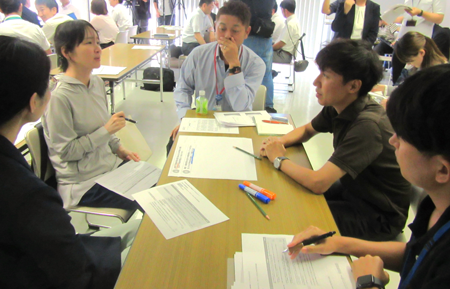
In the group discussions, teachers from the Kanto region and Hiroshima were divided into groups of about four and actively discussed two themes related to school trips to Hiroshima: (1) perspectives and initiatives for enhancing the quality of on-site learning in Hiroshima (what on-site learning in Hiroshima should be like) and (2) how pre- and post-excursion learning can be connected to on-site learning in Hiroshima and further developed into school-wide activities. In one group, teachers exchanged opinions about practical examples. A teacher from the Kanto region said, "To help children think about peace as something that concerns them personally, we encourage them to develop assignments connected to their own lives and experiences." A teacher from Hiroshima said, "Rather than asking children to think about peace right away, we have them start by researching topics they are interested in, such as the Carp baseball team, which eventually leads them to Hiroshima 80 years ago." In another group, when asked by a teacher from Hiroshima, "Why do you go on a school excursion to Hiroshima?" participants responded with answers such as "Because it is a place affected by nuclear weapons, which still exist in the world and could potentially be used today" and "Because it is a place where atomic bomb heritage sites remain visible throughout the city." In the subsequent general presentation, the "Hiroshima Peace Note" created by Hiroshima City received high praise, with participants expressing a desire to use it as teaching material (in the Kanto region as well). Many participants commented that they wished they had more time for discussion.
On the second day, the program focused on learning about the realities of the atomic bombing, including visits to the Hiroshima Peace Memorial Museum and the Honkawa Elementary School Peace Museum, tours of memorial monuments, and a poem reading experience. During these activities, participants listened intently to accounts such as the reasons why so many junior high school students lost their lives and the story of the only surviving student at Honkawa Elementary School. A participant commented, "I was also able to appreciate the volunteers' intentions. I was deeply moved to see each of them learning, reflecting, and carefully conveying their messages."
 In FY2026, the program will be expanded to cover 414 public junior high schools in Kanagawa Prefecture, with plans to further enhance its content.
The costs will be covered by the Hiroshima Peace Culture Foundation (HPCF), and we warmly invite schools and teachers interested in peace studies to participate.
In FY2026, the program will be expanded to cover 414 public junior high schools in Kanagawa Prefecture, with plans to further enhance its content.
The costs will be covered by the Hiroshima Peace Culture Foundation (HPCF), and we warmly invite schools and teachers interested in peace studies to participate.
Group discussions among teachers from the Kanto region and Hiroshima
At the beginning of the first day, Fumiaki Kajiya, a former elementary school principal, shared his testimony as a hibakusha. Participant remarks included "Every word carried weight" and "I felt the overwhelming reality that only someone who lived through that time could convey."
In the presentations on peace study initiatives, Tsukuda Junior High School in Chuo Ward shared their inter-school exchange with Koi Junior High School in Hiroshima City, conducted both online and on-site. Onarimon Elementary and Junior High Schools in Minato Ward presented on the process they went through in deciding to take a school excursion to Hiroshima.
In the group discussions, teachers from the Kanto region and Hiroshima were divided into groups of about four and actively discussed two themes related to school trips to Hiroshima: (1) perspectives and initiatives for enhancing the quality of on-site learning in Hiroshima (what on-site learning in Hiroshima should be like) and (2) how pre- and post-excursion learning can be connected to on-site learning in Hiroshima and further developed into school-wide activities. In one group, teachers exchanged opinions about practical examples. A teacher from the Kanto region said, "To help children think about peace as something that concerns them personally, we encourage them to develop assignments connected to their own lives and experiences." A teacher from Hiroshima said, "Rather than asking children to think about peace right away, we have them start by researching topics they are interested in, such as the Carp baseball team, which eventually leads them to Hiroshima 80 years ago." In another group, when asked by a teacher from Hiroshima, "Why do you go on a school excursion to Hiroshima?" participants responded with answers such as "Because it is a place affected by nuclear weapons, which still exist in the world and could potentially be used today" and "Because it is a place where atomic bomb heritage sites remain visible throughout the city." In the subsequent general presentation, the "Hiroshima Peace Note" created by Hiroshima City received high praise, with participants expressing a desire to use it as teaching material (in the Kanto region as well). Many participants commented that they wished they had more time for discussion.
On the second day, the program focused on learning about the realities of the atomic bombing, including visits to the Hiroshima Peace Memorial Museum and the Honkawa Elementary School Peace Museum, tours of memorial monuments, and a poem reading experience. During these activities, participants listened intently to accounts such as the reasons why so many junior high school students lost their lives and the story of the only surviving student at Honkawa Elementary School. A participant commented, "I was also able to appreciate the volunteers' intentions. I was deeply moved to see each of them learning, reflecting, and carefully conveying their messages."
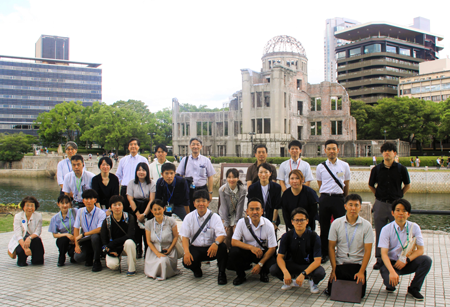
Participants from the Kanto region, together with Tamaki Okuhara, former principal of Honkawa Elementary School (far left), and staff from the HPCF
〈Participants' feedback〉
- It was a highly fulfilling and educational training session. I was reminded of the importance of visiting Hiroshima or Nagasaki during one's formative periods. I also learned the value of gradually deepening peace studies over the three years of junior high school. I hope Hiroshima will more widely promote the significance of these initiatives.
- I felt that peace education is deeply rooted in Hiroshima's schools and that teachers there demonstrate a strong sense of awareness and passion. It was especially rewarding to see young teachers enthusiastically promoting peace studies. I would also like to learn more about the theories of peace studies by the professor from the School of Education at Hiroshima University.
- The Peace Volunteers' explanations were very easy to understand. I would like to include similar activities in school excursions as well. The inter-school exchanges were also particularly impressive. I would like to learn more about the monitor school system.
- I was initially worried about whether it was appropriate for someone like me, who knew very little about peace studies, to participate, but the people of Hiroshima welcomed me very warmly. Interacting with such passionate teachers not only strengthened my motivation but also deepened my knowledge, making me even more determined to plan and implement school excursions to Hiroshima.
- The program was wonderful, and I feel that even more people will participate in the future. I will encourage my fellow teachers to participate (in this teachers' meeting), and I also hope that the number of school trips to Hiroshima from the Kanto region will increase, even a little, so that we can pass on the stories of Hiroshima and the message of peace to future generations of students.
"Teachers from the Kanto Region Invited to Hiroshima, the Atomic-bombed City, to Discuss the Role of Peace Studies in School Trips" (TSS News)

(Peace Studies Division)