
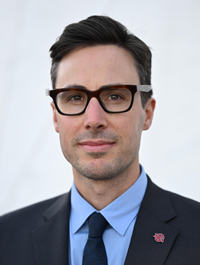
Tim Wright
Treaty Coordinator at the International Campaign to Abolish Nuclear Weapons (ICAN) and the initiator of the Children's Peace Memorial

The fact that children would suffer the greatest harm of all in the event of a nuclear attack against a city today must be central to discussions about the increasing global threat posed by nuclear weapons, and spur united action for their elimination.
In the US nuclear bombings of Hiroshima and Nagasaki eight decades ago, more than 38,000 children were killed, according to official estimates, with countless more suffering severe physical scars and psychological trauma.
The burnt tricycle of three-year-old Shinichi Tetsutani, now on permanent display at the Hiroshima Peace Memorial Museum, has become a well-known symbol of the harm inflicted on children. At the time of the bombing, he was riding the tricycle and sustained major injuries. He died several hours later. His two sisters, Michiko and Yoko, were also killed.
"This should never happen to children," their father, Nobuo, reflected years later. "Please work to create a peaceful world where children can play to their heart’s content."
There is clear scientific evidence that, in a nuclear attack, children are more likely than adults to die from burn injuries, as their skin is thinner and more delicate; to die from blast injuries, given the relative frailty of their bodies; and to die from acute radiation sickness, as they have more cells that are growing and dividing rapidly.
They are also less able to free themselves from collapsed and burning buildings or take other steps in the aftermath of an attack to increase their chances of survival.
In the long term, children are more likely to suffer from cancers and other illnesses as a result of the delayed effects of radiation damage to their cells, and more likely to suffer privation and mental health disorders leading to suicide.
Furthermore, babies who were in the womb at the time of a nuclear attack are at greater risk of death soon after birth or in early childhood; intellectual disabilities given the higher vulnerability of the developing brain to radiation damage; growth impairment due to the reduced functioning of the thyroid; and cancers and other illnesses during childhood or later in life.
These horrifying realities should have profound implications for policy-making in countries that currently possess nuclear weapons and in those that support their retention and potential use as part of military alliances, including Japan.
Over the past two years, the International Campaign to Abolish Nuclear Weapons (ICAN) has made a determined effort to highlight the unique and disproportionate harm suffered by the children of Hiroshima and Nagasaki, as well as children living downwind or downstream of the dozens of nuclear test sites globally.
In 2024, we published a detailed report on this topic, and in 2025 we launched the Children’s Peace Memorial—a website featuring profiles of more than 400 children killed in Hiroshima and Nagasaki, with heart-wrenching details of their short lives, agonising deaths and the grief of surviving family members.
The memorial’s creation was inspired by the lifetime's advocacy of Setsuko Thurlow, who survived the Hiroshima bombing as a 13-year-old girl. In many of her public lectures, she holds up a large yellow banner bearing the names of the students and teachers from her school who were killed. This, she says, helps her audience grasp the sheer scale of death and destruction.
"As I show this to you, I want you to feel and imagine that each name here represents an individual human being, a real person who was loved by someone and who was engaged in his or her life until 8:15 that morning," she implores.
One of the earliest efforts to disseminate the stories of children killed in Hiroshima was a 1954 publication titled Our Recollections, profiling 86 boys from the First Hiroshima Prefectural Junior High School. Most of the accounts were written by their grieving parents.
"As one of the bereaved, I would be more than happy if these essays, written by the families of the deceased, were read by as many people as possible, so that humankind could be spared a recurrence of such tragedy," wrote Masayuki Akita in an introduction to the anthology.
It is in this spirit that we chose to retell these and other children's stories through the online memorial. We hope that it will help to awaken the global public to the grave and growing threat posed by nuclear weapons — and ensure that no one else, young or old, ever suffers a similar fate.
This, of course, can only be guaranteed through the total abolition of nuclear weapons. We believe that the TPNW provides the most promising pathway towards that goal. It not only prohibits nuclear weapons in a comprehensive manner, but also establishes frameworks for their verifiable, irreversible elimination and for assisting victims of their use and testing.
A majority of the world’s nations have already joined it, either as parties or signatories, and more are poised to do so. Each new signature or ratification strengthens the global norm against the worst weapons of mass destruction, and creates pressure and momentum for their abolition.
In the words of the UN Secretary-General, António Guterres, "Nuclear weapons are the most destructive power ever created. They offer no security — just carnage and chaos. Their elimination would be the greatest gift we could bestow on future generations."
(January 2026)