
Dialogue between Mayors and Youth at the Tama Peace Summit
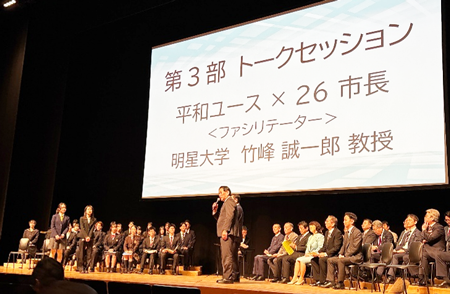
On February 15, a "Peace Summit marking the 80th anniversary of the end of World War II" was held at the Parthenon Tama Grand Hall (Tama City, Tokyo) organized by Tokyo Tama Regional Peace Network of Mayors for Peace.
Kazumi Matsui, Mayor of Hiroshima, attended as a guest.
At the summit, a group of "Tama Region Peace Youth" (26 high school and college students residing in the 26 member cities of the Peace Network) delivered messages of peace to the attending mayors, drawing on their experiences during a study tour to Hiroshima last August.
The subsequent dialogue between the Peace Youth and the 26 mayors led to a fruitful exchange, as described below.
Q. Takashi Kawamura, Mayor of Mitaka
"Can we say that Japan has been peaceful, since it hasn't waged war in the 80 years since the end of World War II?"
A. Asuka Yamanaka, Peace Youth from Mitaka City
"'Peace' has more than one meaning.
While eliminating nuclear weapons is a critical aspect, smaller forms of peace like having a home, getting enough to eat every day, or having the peace of mind that comes from knowing that a bomb won't fall tomorrow are also critical.
From that point of view, Japan has generally enjoyed peace over the past 80 years, but the world still has nuclear weapons and some people don't get enough to eat, so we can't say that everyone lives in peace."
Q. Norio Takano, Mayor of Fuchu
"Peace and human rights are closely linked.
Could you share instances where you feel human rights are being disregarded in your community, and conversely, instances where you get a sense of peace from human rights being respected?"
A. Wakako Yoda, Peace Youth from Machida City
"I feel my human rights are violated when a certain set of values is forcefully imposed to constrain my career path or way of life; conversely, in the flow of ordinary life—like studying at school, eating a proper meal, or sleeping under a warm blanket—a feeling of peace can suddenly wash over me."
Q. Takashi Ikezawa, Mayor of Nishi Tokyo
"Based on what you learned here, what are some ways the peace education you received in elementary and middle school could be improved?"
A. Yuzuki Sakagami, Peace Youth from Nishi Tokyo City
"Colleges offer fewer opportunities to study peace than high schools do.
We really need them to offer more.
Also, starting in elementary all the way up students need to be involved in designing their own peace education."
Q. Teppei Maruyama, Mayor of Kokubunji
"How can we connect issues like the Russia-Ukraine conflict and the situation in Israel to peace education in Japan today?
How can we communicate them in a way that feels real to children?"
A. Aoi Kobayashi, Peace Youth from Fussa City
"Rather than focusing only on people who are already interested in peace, distributing free papers and similar materials at events could help broader audiences casually encounter messages about peace and encourage them to begin learning more about these issues.
If we offer pamphlets at local festivals and sports events, people might start to think—even a little—how lucky they are to have been born into a peaceful and prosperous society."
Candid, unscripted exchanges of views like the above between the Peace Youth and the mayors created a pleasant, fruitful tension for both the speakers and the audience.
We hope that Peace Youth will continue to play vital roles in supporting the culture of peace in Tama.
Talk Session
(Peace Culture Planning Division)